
Renaissance scientist?
Review of Leonardo: The First Scientist by Michael White

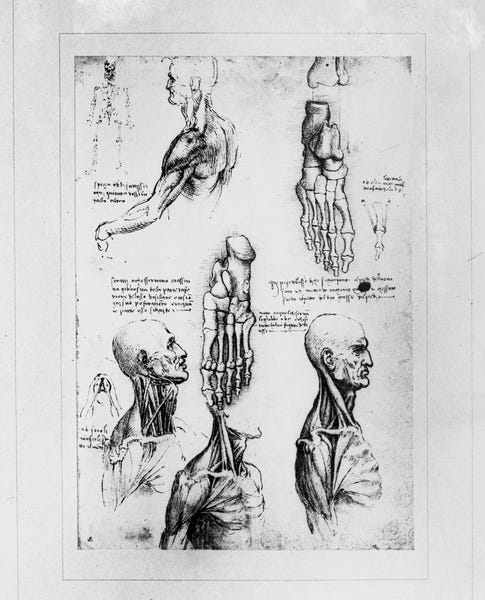
In concentrating on Leonardo's investigations in his notebooks, White's contention is that Leonardo da Vinci was acting as a scientist, perhaps the first modern one: using acute observation and direct experiment to test theories that he was formulating. While Leonardo was certainly experimenting and formulating theories, the premise of the book depends on how you define science. If it is experimentation to validate and change your theories accordingly, OK. But if you mean participating in a community that shares a larger theoretical foundation and then communicating your results for peer review, which Kepler and Galileo did, Leonardo most definitely was not a modern scientist: he kept his notebooks to himself and feared plagiarism almost paranoically.
Unfortunately, White leaves the definition unclear and so turns his book into a strange kind of anachronistic exercise. If you focus on the work of other innovators, you can argue that they were “the first modern scientists.” Some hundreds of years before Leonardo, the builders of gothic cathedrals appear to have had geometric concepts (mathematics), which they carved into massive stone structures by trail and error (experiment); they also had an overarching, highly logical intellectual system, scholasticism, that was adaptive and very rich. Why not argue that they were the first “real” scientists?
Moreover, it is not even clear that White wants to systematically argue that Leonardo was “first,” but merely that he was a pioneer. Does it even make sense to argue such a thing? What does it really add? We all know he was a genius who was largely self-educated and hence did not share the Aristotelian assumptions inherent in scholasticism. But Leonardo was not systematic: with the exception of his great anatomical studies, he jotted thing down most things privately and in code, so you really have to interpret a lot of things heavily to find consistent meaning in them.
Nonetheless, this was the first bio I read of Leonardo and it was quite interesting. Indeed, it gave me an appetite to seek more on him, though I will go for his art in the next go. It covers many of the standard details adequately and is written clearly, even beautifully. When the author speculates, which I think he does far too often, he at least makes it clear that that is what he is doing.
This is an odd book. I think that its main problem is that White is a popular science writer who is trying to say something original as well. I by no means wish to disparage gifted amateurs from pursuing their own investigations, but he was out of his depth.
Related review:
Hi Rob. Da Vinci was amazing, wasn’t he? I noticed I can listen to your posts now rather than read them myself. I want to do that with my Substack posts but don’t know how. Can you direct me to where I can learn more about how to do this?